Cognate
The connected fabric
of your life.
Every part of your life in one place — work, personal, your mail and calendar, the people, the commitments, the projects, the reading, the notes — where it all connects itself, sorts itself by which hat you're wearing, and stays on a machine you own.
Request an invitationMac, iPhone and iPad only. No Windows or Android yet.
30 days free · founding membership $279 a year, for life · no card to start
Not ready yet? Take the tour first — every part of Cognate, in detail.
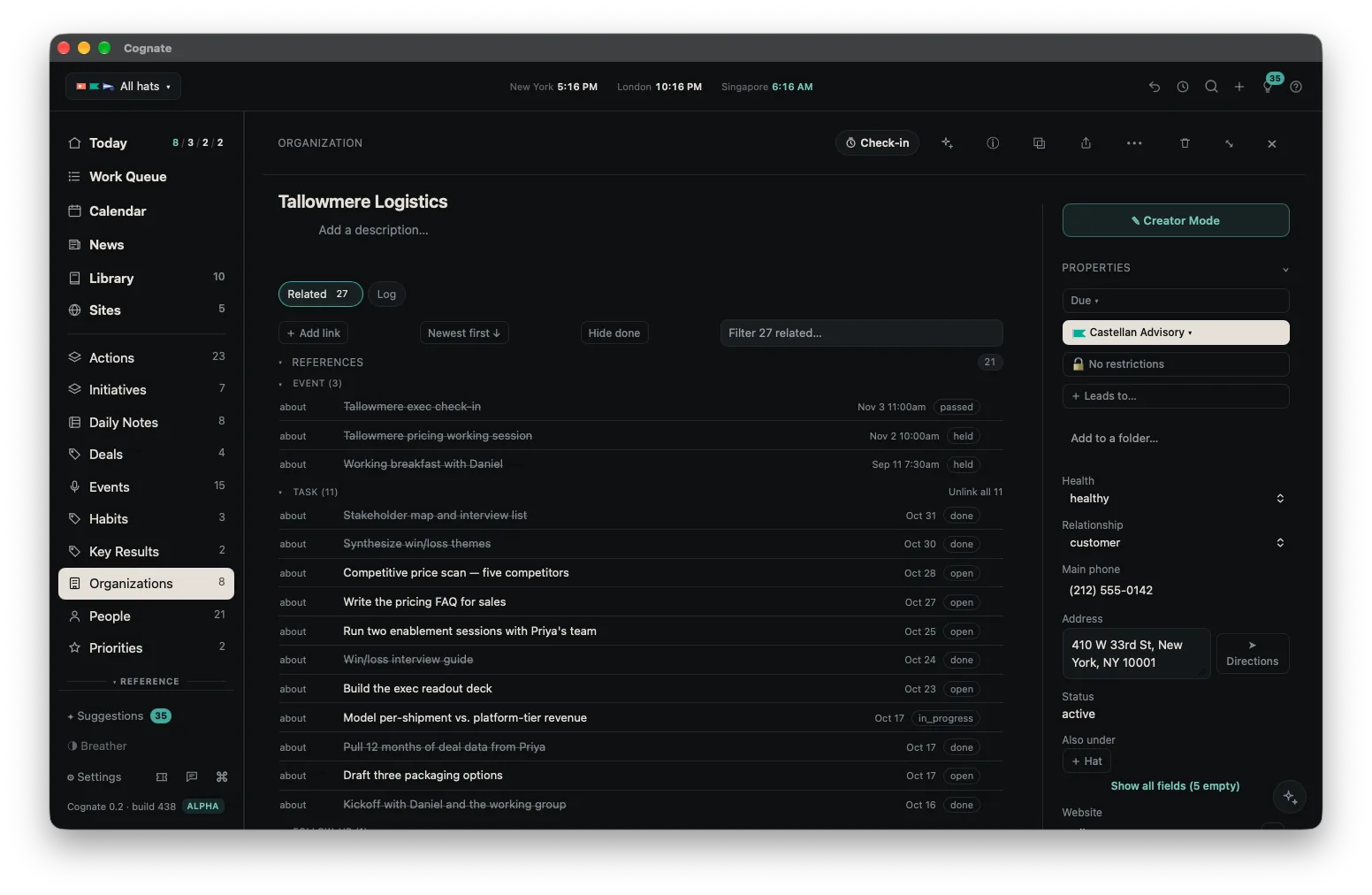
A different way of working
Your inbox has been doing a job it was never built for.
Not because anyone chose it. Because it is the one place everything already passes through — your team, your clients, your bank, your kid’s school. So we all leave messages sitting there, and we leave them for quite different reasons. This one is the record that they agreed to the number. This one is a task nobody has started yet. This one is an idea worth coming back to when there is time. So many jobs, one pile, and nothing to tell them apart. Then there are four thousand of them, and a folder structure, and a rule you wrote in 2019 that you are slightly afraid to delete.
Everything else got the same treatment. The tab stays open because closing it loses the thought. The note gets written twice because you can't remember where the first one went.
And so you became the index.
In Cognate the message files itself, into the project and the person and the organization, and it asks you first. It’s not so much clever as it is just what should have been happening all along.
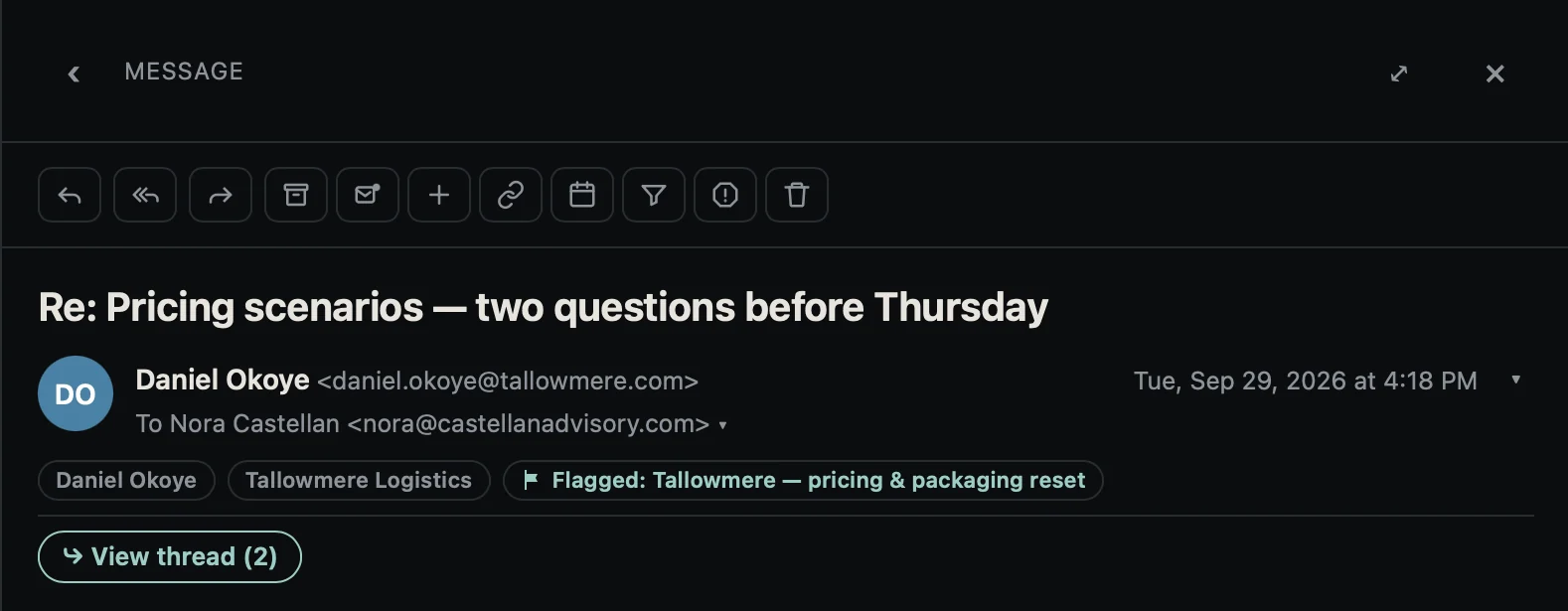
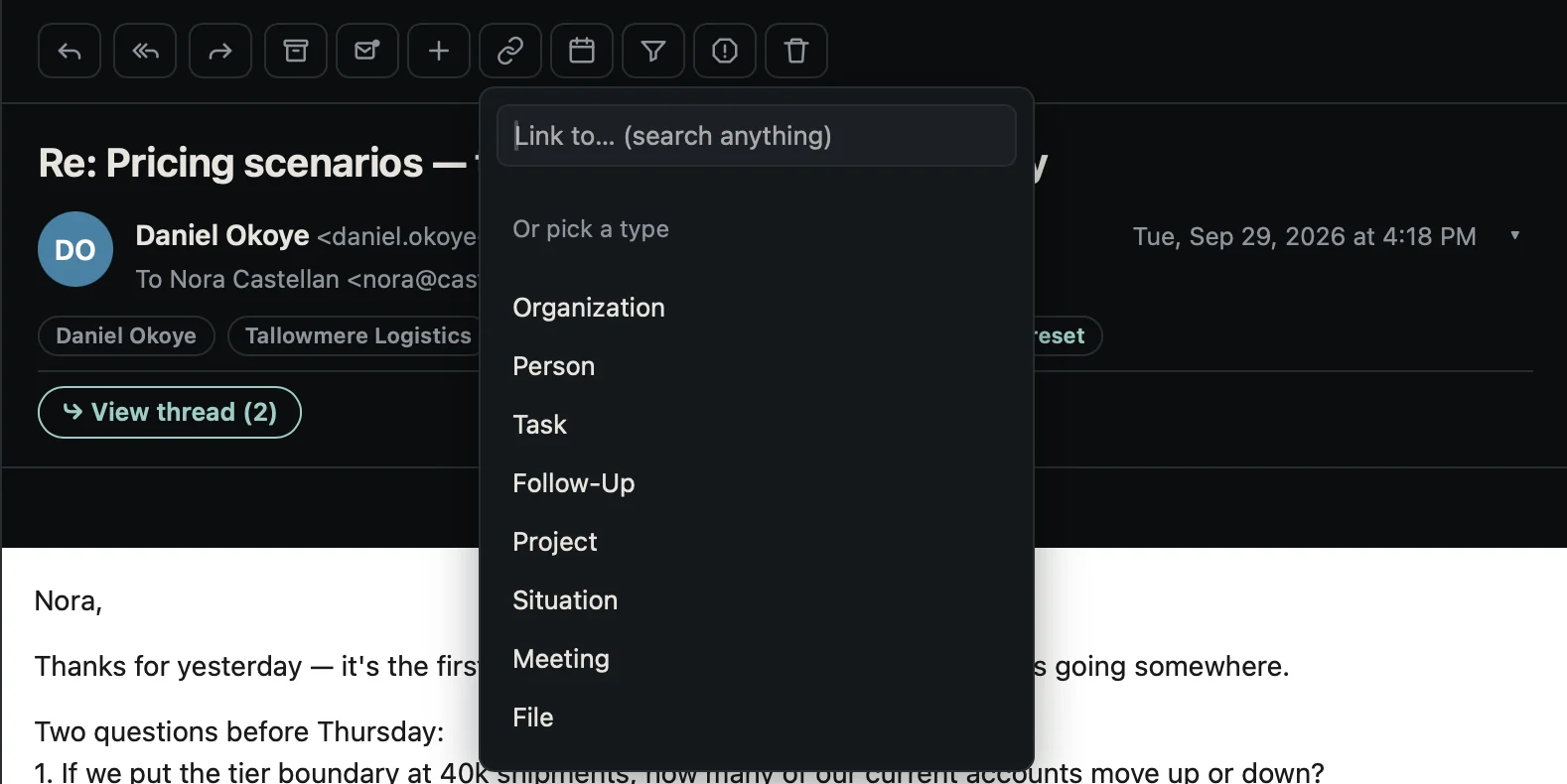
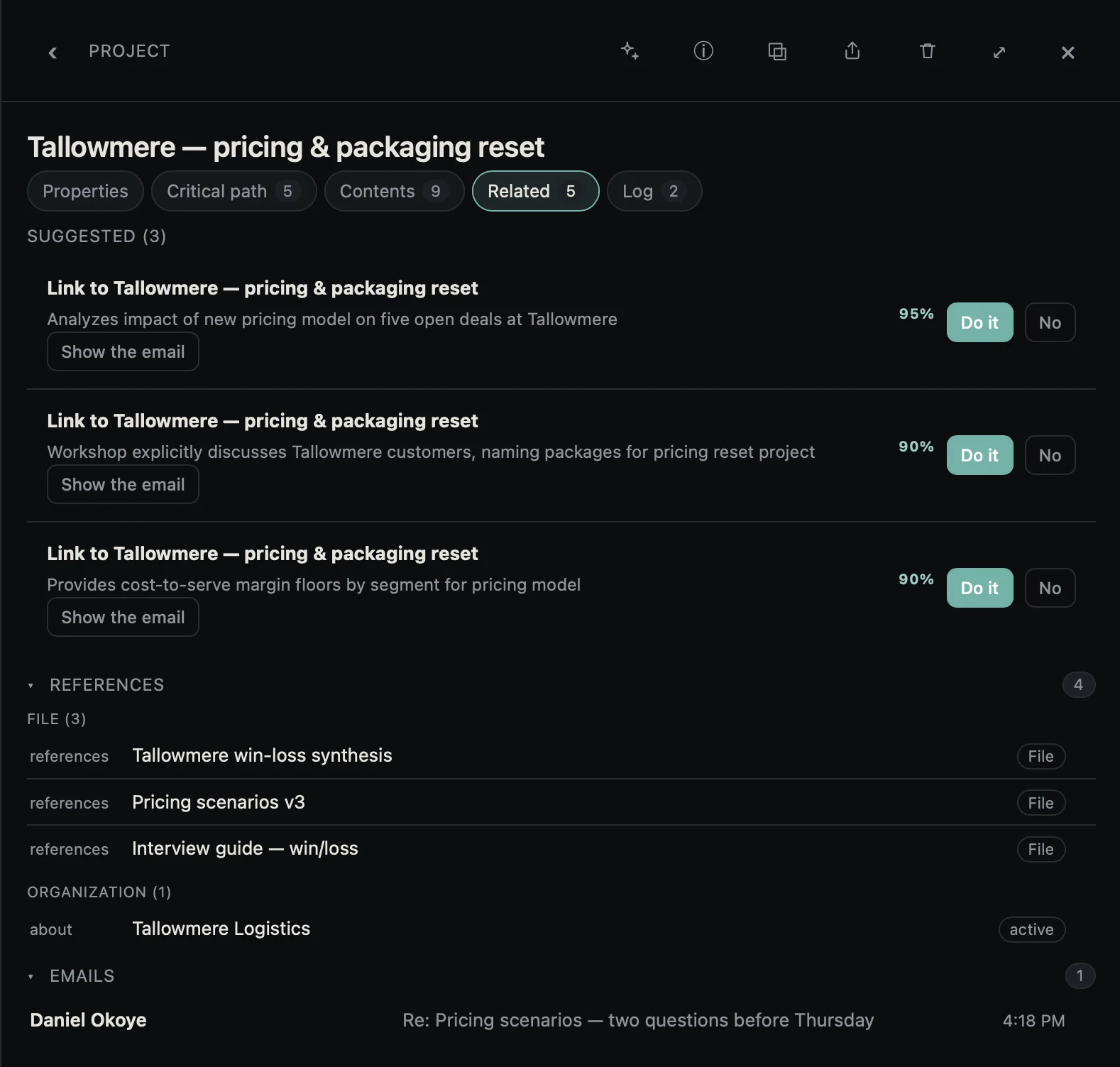
Nothing is summarized away and nothing is retyped. The message stays exactly what it was, and it is at the same time part of the project it concerns, the person who sent it and the organization behind them. When you do want it to become something, a task or a follow-up, one gesture does that too, and the whole thread comes with it.
Which is why inbox zero stops being a discipline and becomes a side effect. You archive without hesitation, because there is nothing left in there that isn't now somewhere better.
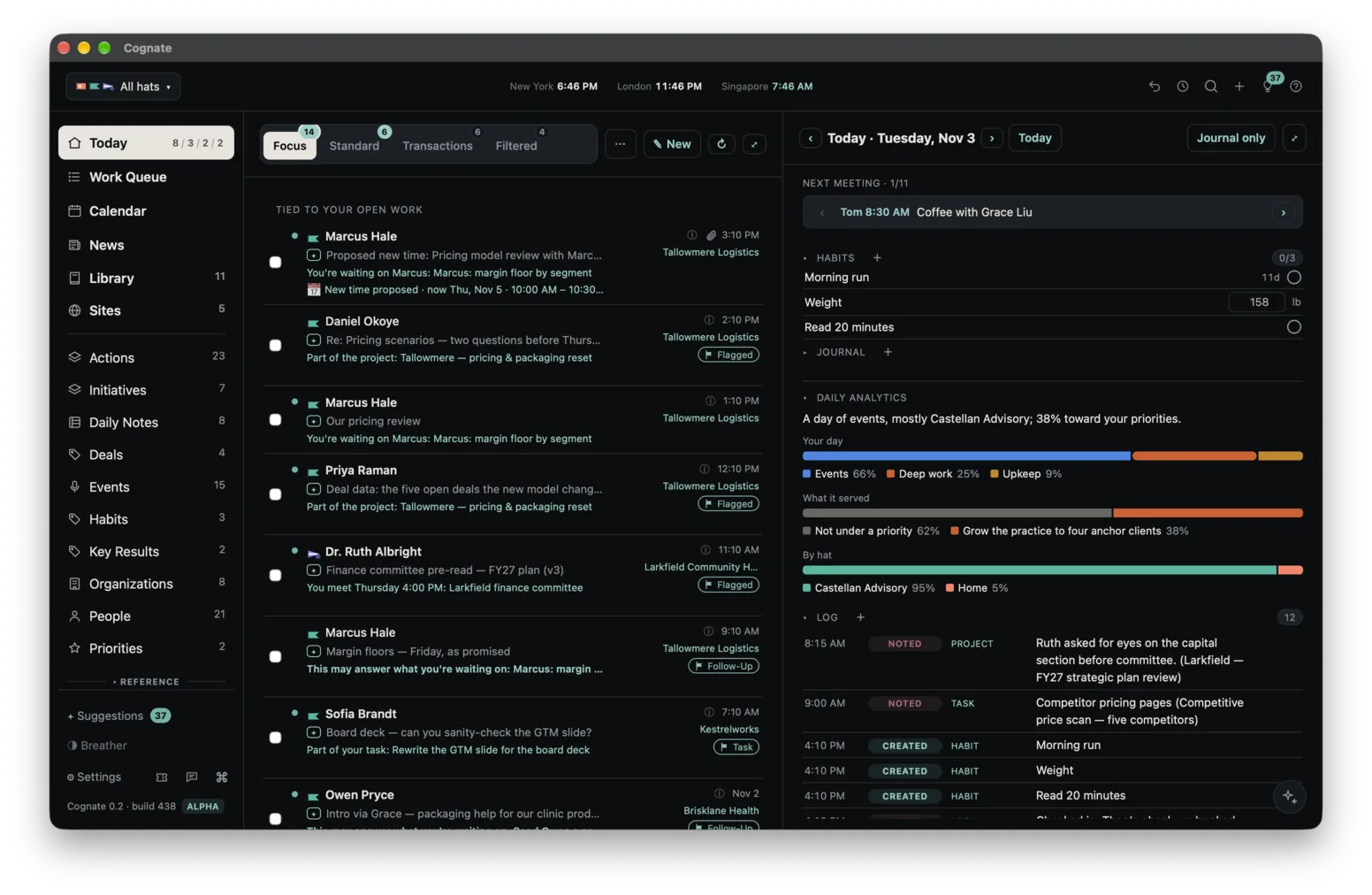
Every hat, one plane
You have one life. It has never been one context.
A day job, a board or a volunteer position, a couple of clients, a family. Different people, different obligations, different tolerances for interruption — and quietly, different rules about what may be seen and by whom.
Cognate calls them hats. Everything belongs to one, and each carries its own bar for what reaches you, so a loud hat never drowns an important one. Work inside a single hat and see nothing else, combine a few of them, or stand above them all and catch the Thursday where three collide.
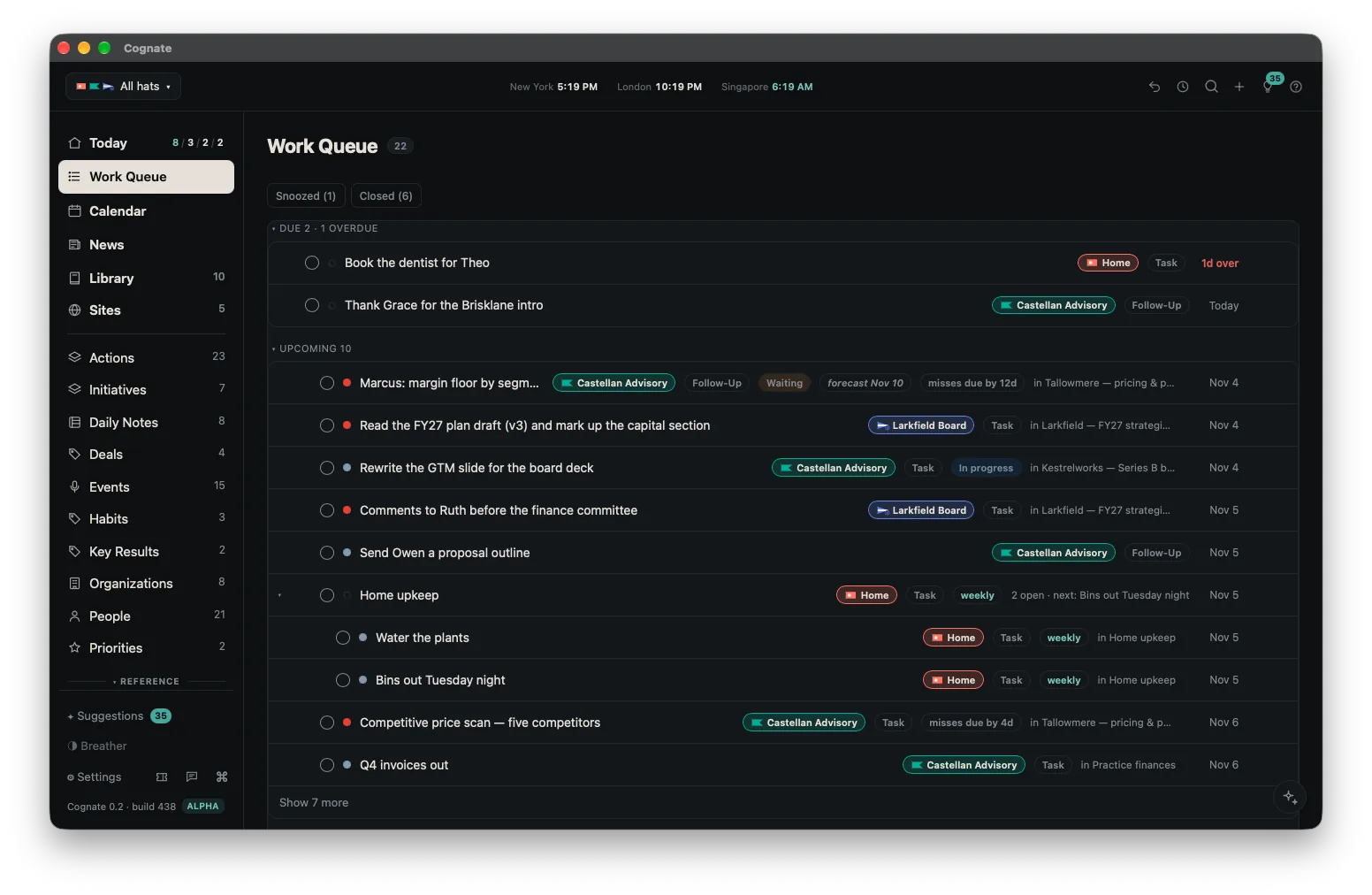
Everything, together
One place, so you can stop being the one holding it together.
The average knowledge worker opens eighteen applications a day and switches between them thirty-three times — hours spent on nothing but the crossing. Cognate elegantly consolidates the ones you were only running because nothing else would hold that part of your life.
People
A personal CRM that fills itself from the traffic. Open someone before a one-to-one and it is already there: what you owe them, what they owe you, every thread you are both in. Chase any of it in one click.
Tasks & projects
Real plans, with the structure a real plan needs. Milestones, decisions, dependencies without loops, a critical path, and a runway measured from the pace you actually keep — your picture of the work, however much or little of it you control.
Events & meetings
The part of the week that takes the most arranging and leaves the least behind. Cognate offers times that suit your day, holds them on every calendar you have, pads for the travel, and brings the context into the room with you. Recording is the easy half: on your Mac, where the audio stays, after which what was said becomes a task where it is yours and a follow-up where you are waiting on them.
Priorities
What matters this quarter, held as a real thing rather than a note, so you can see whether the week moved anything that counts.
Reading
A reader that scores stories against what each hat actually cares about, and learns from what you keep. One row per story, however many outlets carry it. Highlight as you read, write your own notes onto it, file it against the work it bears on, and send it to someone with your thinking attached. Newsletters can land here instead of the inbox — Substack, Beehiiv, Ghost — posts in full, one at a time, your call.
The Library
Written pages and real files in one place, and a folder here holds more than files — a task, a project or a person can sit on the same shelf. Anything can sit on several shelves at once, without copies. What goes in is your choice, the way a physical folder is; to see everything about a client you open the client, not a folder. Documents stay ordinary files in a folder you can open. A block editor over typed objects sits on top of all of it.
Journal, log & sites
The quiet layer that remembers when. Your journal for the day, written by you with a nudge if you want one. A log on every record, written by Cognate, of what happened to it and when. And Sites, for the web pages you actually keep. None of it is a feature you go and use; it is what the other seven are standing on.
Habits, boards & the shape of a day
Small things that add up. A habit you tick or log, with its streak, its chart and a quiet nudge in the evening — and from an iPhone it writes to Apple Health, never reading anything back. Any note holding pictures or links opens as a board: tiles with their own pictures and prices, which is where a shopping list or a mood board goes. And Daily Analytics, which reads the day you actually had and shows you what it served. None of this is why you would buy Cognate. All of it is one more thing you can stop paying for.
Places
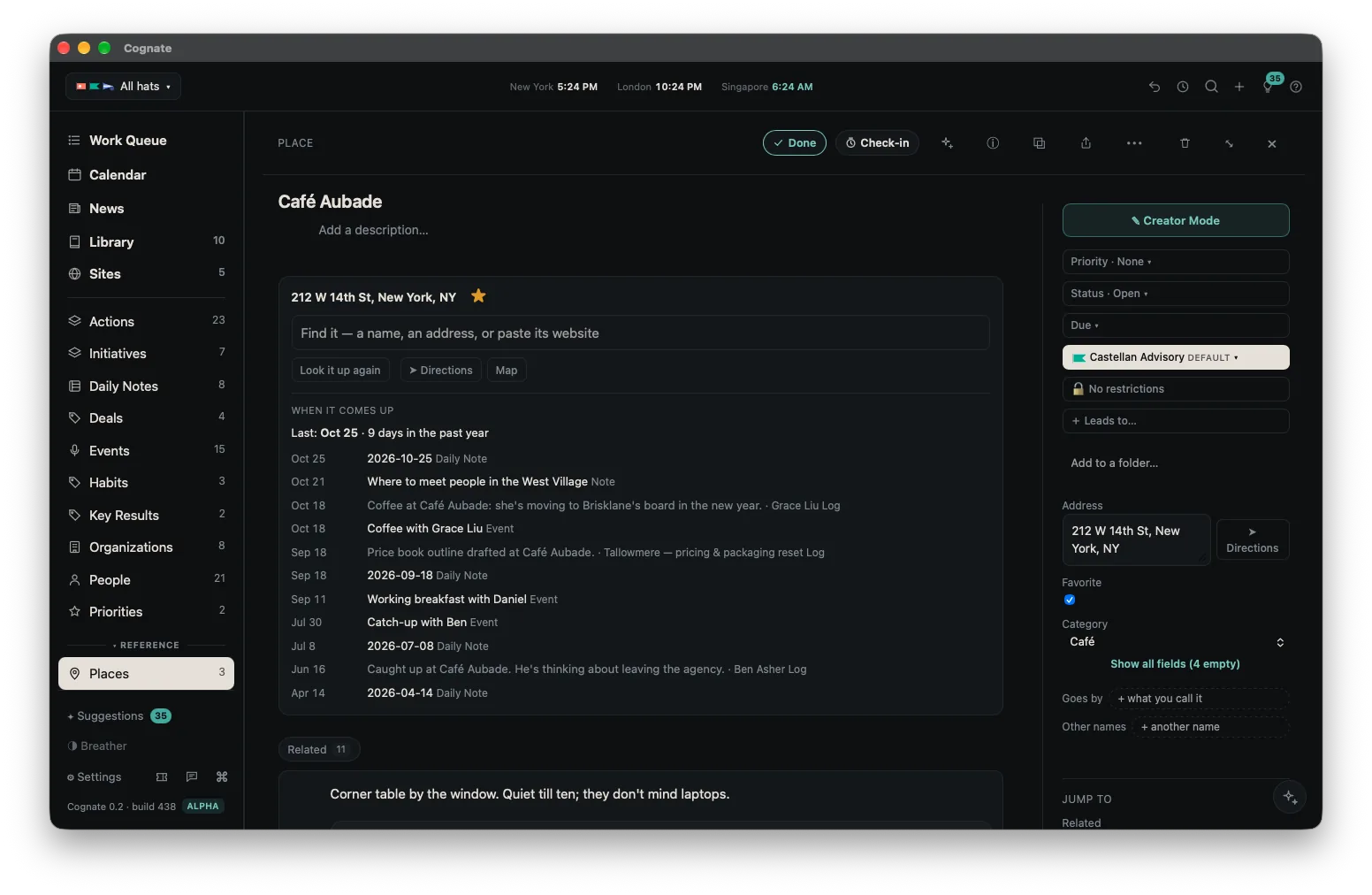
Where things happened, kept without you keeping it. Mention somewhere in passing and the Place is made and filled in — then carries every time it has come up since.
These are not integrations. These are merely different parts of the same fabric of your life. A single data model, one set of links, and one idea of who everybody is — which is why the person knows about the project, and the project knows about the document.
Single-player by design. Nobody to invite, no permissions to manage, no shared board that only you keep current. When something waits on a person, that is a link to their record, so you can see everything they owe you before a one-to-one. It is not a request for them to log in.
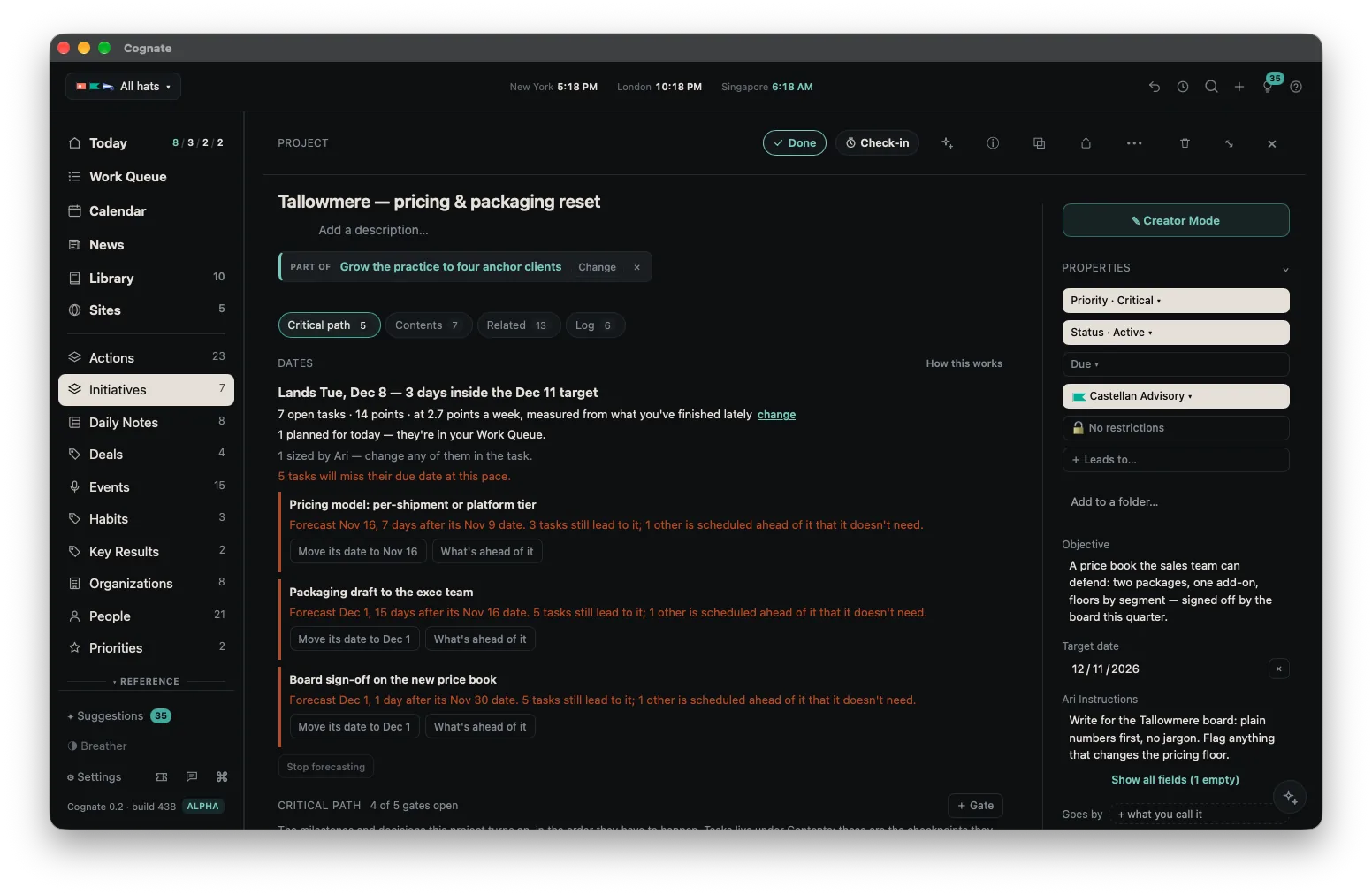
Where it sits
Your mail stays where it is. The way you work with it doesn't.
Nothing migrates. Cognate signs in to Microsoft 365, Google Workspace, iCloud, or plain IMAP and CalDAV — several at once, which is the normal condition for anyone with more than one life, who wears multiple hats — and reads and writes straight to them. Archive something here and it is archived there. Disconnect tomorrow and your mail is exactly where it always was.
What changes is the experience on top: every account in one triage, every calendar in a single view, transparent when you want it to be, distinct when you need it to be, and all of it feeding the same fabric as everything else.
Because it knows who everyone is, it can sort — not by rules you wrote in 2019 and are now afraid to delete, but by whether this is someone you actually deal with, whether you owe them an answer, and whether the thread belongs to work you are in the middle of. Mail from real people rises — and it says why it did, in a line under the subject that opens the thing it means. Receipts, confirmations and alerts fall into a lane of their own and stop competing for the same attention — and all those subscriptions you want only when you have time to want them are instantly segregated, and always just one click from unsubscribed.
And the calendar problem is finally solved. Every meeting arrives with its context already attached — the people, what you last agreed with them, the thread it came out of, the document you will want in the room. Ask for times and it proposes them — slots that suit your day and are aligned to your mutual time zones, held while you wait, and the one they pick is booked; when their time zone is not yours it keeps inside their working hours. Book something on one calendar and the time is held on all the others, so the thing your work calendar cannot see stops getting booked over.
Everything belongs to one of your lives. The connections form themselves. An assistant that already knows the situation.
Everything here is Cognate's — except mail and calendar, which read and write straight to the accounts below.
Context you never gave it
Half of what it knows, you never typed.
Mail is the obvious source. It is not the only one — and the others are why the record fills itself instead of waiting on you.
Mention a place, and it keeps the place
Write a line in your journal about dinner somewhere. Cognate finds it, makes a Place, and fills in the address, the hours, the position and what kind of place it is — from the venue's own site and the map. Years later that Place carries every time it has come up: the journal lines, the notes, the meetings held there, each dated. All you ever did was write one sentence about dinner.
A browser, because the web is context too
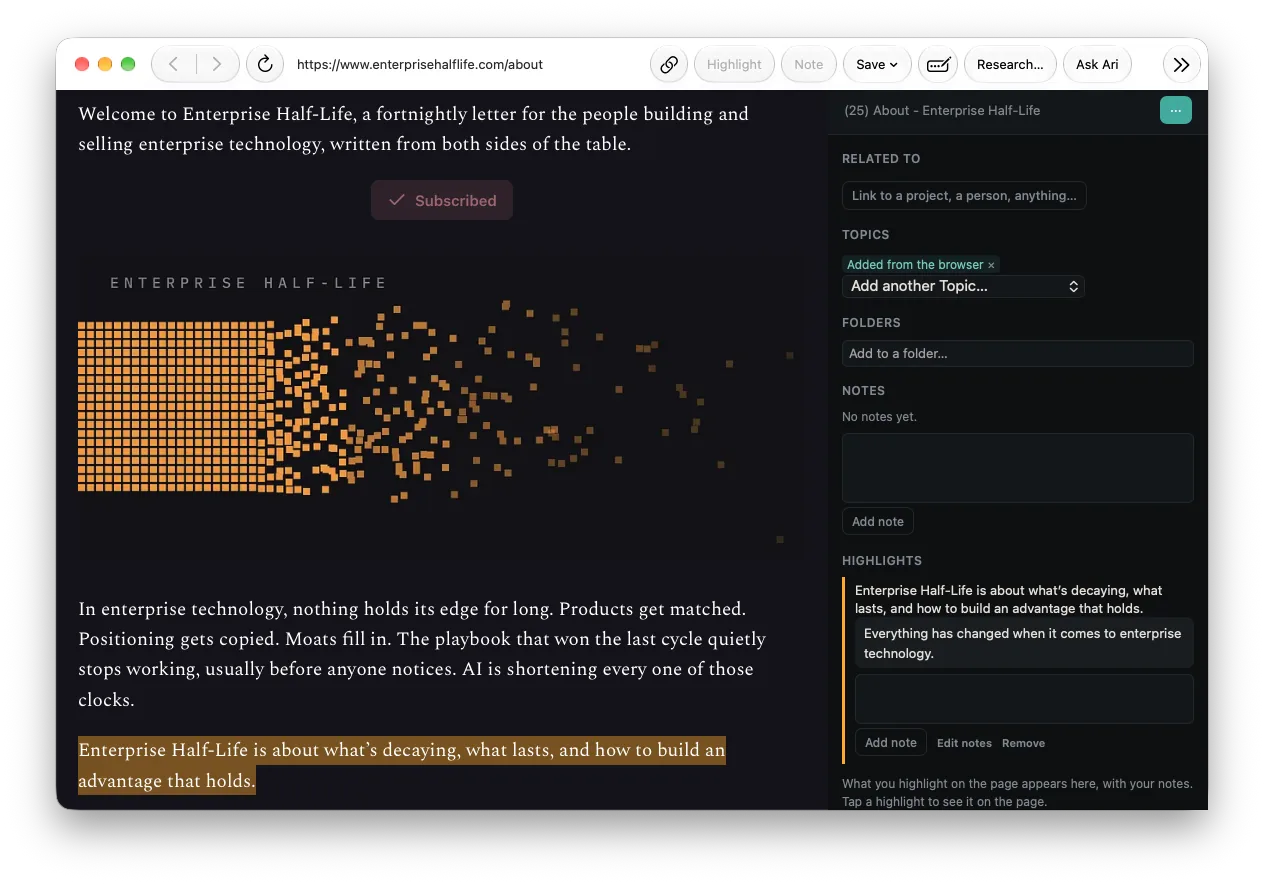
Not a general-purpose browser, and not trying to replace yours (but it might!). A page you are reading is context — and context that arrives through a separate app can't be filed, linked or asked about. Read it inside Cognate and it can be: highlighted on the page, kept in the Library, and answered on by Ari with everything else she knows still in view.
A photograph becomes the thing it shows
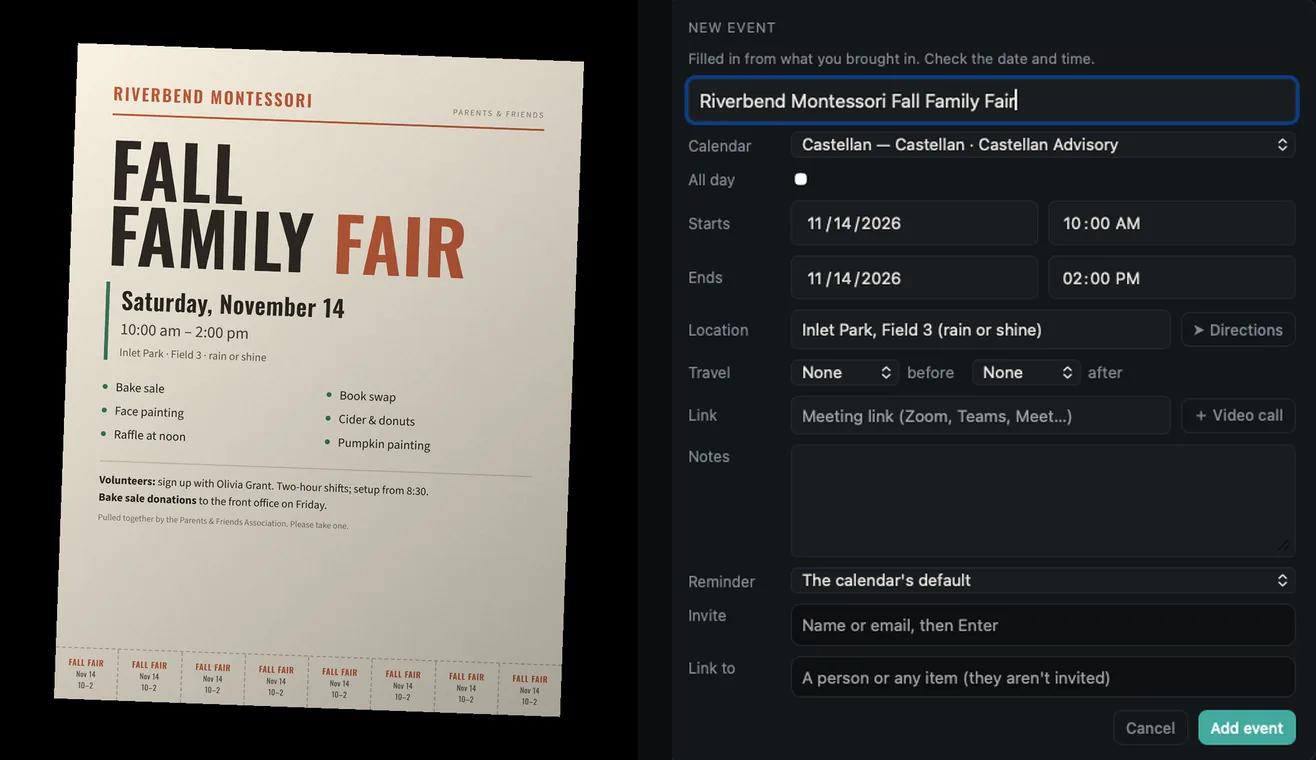
Point your phone at an event flyer and Cognate offers the Event, filled in, with the picture attached. A business card offers the Person. A venue's card offers the Place. Nothing is created until you say so — and when you do, the document is already linked to what it produced.
Documents arrive already read
A file that lands in the Library is read on arrival, filed against the thread and the task it answers, and searchable inside — including scans. You are not asked where to put it, because the thing it belongs to is already in the record.
Ari
An assistant that already knows the situation.
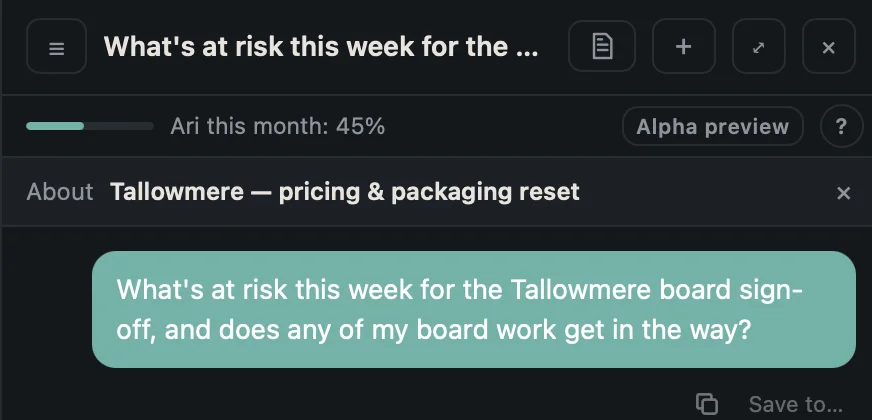
Ask any other assistant where a piece of work stands and it starts from nothing. You paste in the background, it answers, it forgets — and the answer is capped by how much you were willing to retype.
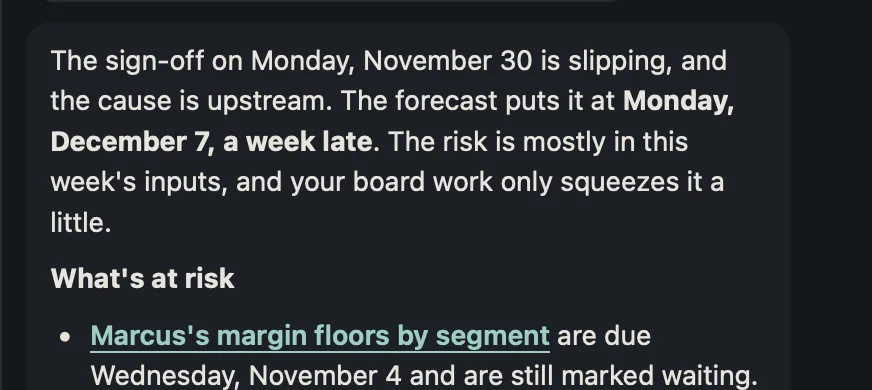
Ari starts from the fabric. She already knows who these people are, what was agreed in March, which hat it belongs to and what is on your plate this week. She has read the document, because it was filed against the thread it arrived in. So the answer comes back situated: not a summary of one message, but where the whole thing actually stands.
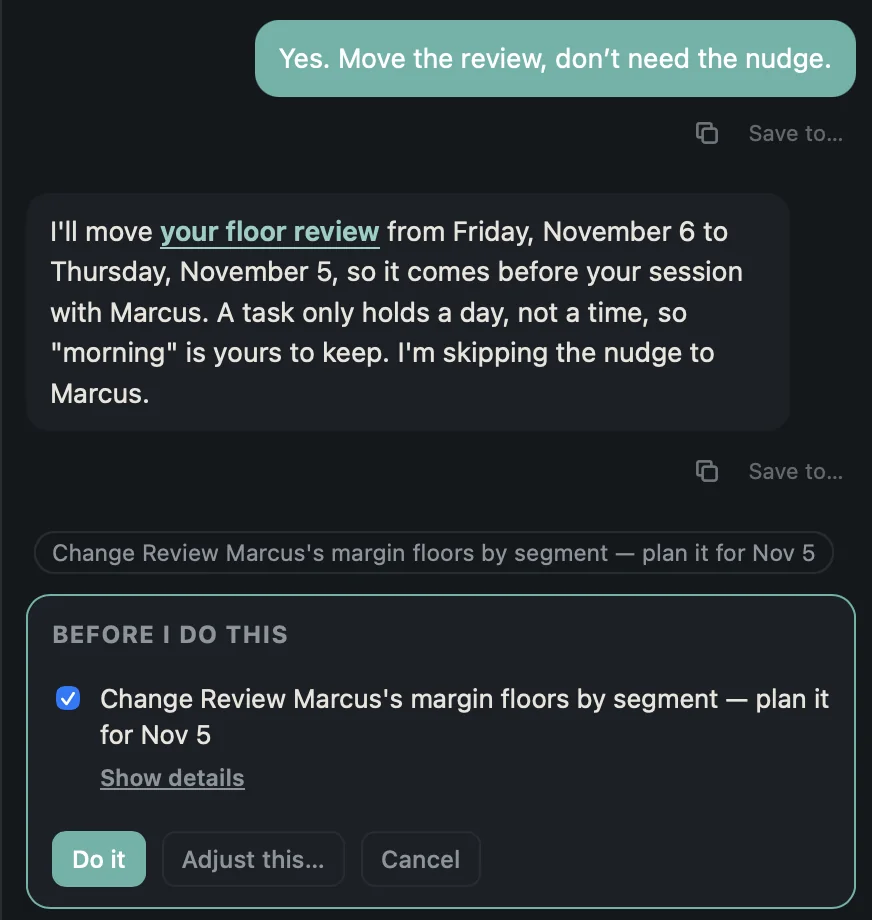
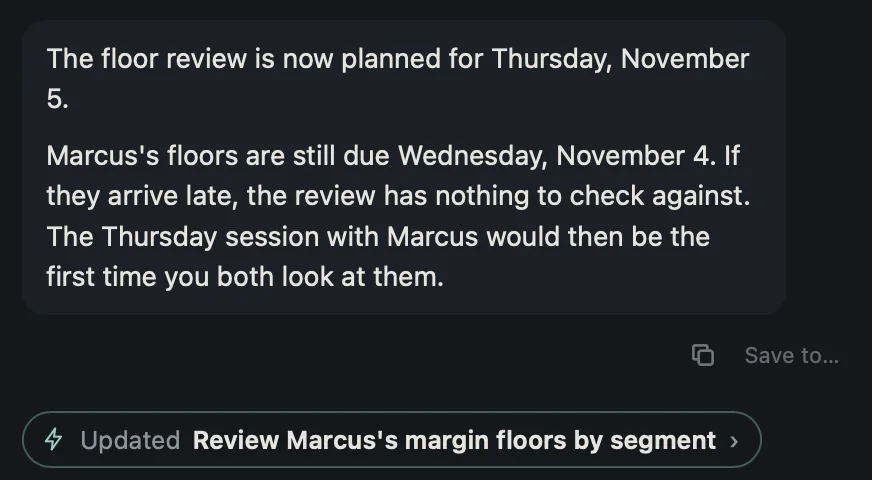
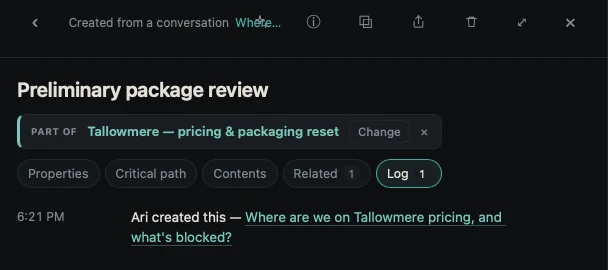
And she doesn't only answer. She creates the task, updates the plan, drafts the reply, books the meeting — always showing you the change first, under a heading that says Before I do this, with a checkbox and the option to skip. Afterwards the record carries its own provenance: Ari created this, linked back to the conversation that produced it.
Included, then yours
A monthly allowance of Ari comes with the membership, with a meter so you always know where you are in it. Past it, add your own key or an Ari Plus top-up. It is never sold as unlimited, because nobody can honestly sell that.
Or yours alone
Prefer nothing metered through us at all? Run on your key exclusively. Requests go straight from your machine to the provider, under your account, with Cognate out of the loop.
Nothing happens behind your back
Reading and connecting happen on their own, which is rather the point of the thing. Acting never does. Every change is shown to you before it is made, and anything marked Keep from AI is never sent at all.
Yours, and quiet
The most personal things you own stay on the machine you own.
Mail indexed locally. Documents as ordinary files in a folder you can open and back up without Cognate. It works with the network off, and sync between your devices runs through your own iCloud — there is no Cognate server holding your content, because there is no Cognate database to hold it in.
Privacy is two switches, because the two fears are different: keep this from AI, and keep this out of exports and sharing. Set either on a hat, a type of thing, or a single item. The strictest setting wins, and every item tells you which rule is in force.
Export everything, in open formats, from the first day. If you leave, the fabric leaves with you.
What it costs
Thirty days free, then thirty-nine dollars.
No card to start, and the trial runs its full length either way. One person, every hat, every device — no seats, nothing to administer.
Today’s price, kept for as long as you stay — not a discount, just the number never moving. Five hundred memberships, annual, and they close for good the day 1.0 ships.
Everyone after that. A monthly allowance of Ari is included either way, with a meter so you can see where you are in it.
Founding membership is not a coupon. It carries a numbered mark in the app, a place on the founders page, a direct line to me, real say in what gets built next, and the private beta for every large feature before anyone else sees it.
Getting started
Your first session with Ari.
Setting up is the part that makes the rest work, and it happens once, as a conversation. Ari asks about your hats, your accounts, the people who matter and what you are in the middle of — and tunes Cognate to you as you answer.
Every tool costs you this. Most take it in fragments, spread over weeks, while you guess at what goes where and discover the setting that mattered three months too late. Cognate asks once, at the start, so that you begin somewhere useful rather than somewhere empty.
Stop at any step. It keeps your place.
Request an invitation.
Cognate is in private alpha, and invitations go out in waves. This is how you ask for one. The questions below are optional and tell me which parts of Cognate matter most to the people asking — there is no line to stand in and no position to lose. The quickest way in has always been an invitation from someone already using it.
One more click.
Check your email and click the link to confirm. It's from hello@trycognate.com, subject Confirm your request for a Cognate invitation — look in spam if it isn't there in a minute. After that there's nothing more to do: we open Cognate a few people at a time, and you'll hear from us when there's a place for you.
Cognate runs on macOS 14 or later, and on iPhone and iPad with iOS or iPadOS 17 or later. Meeting recording needs the Mac, and transcription is English today. AI runs on Anthropic's Claude models, so a bring-your-own key means an Anthropic key. Switching figures: Hubstaff and Lokalise, February 2026.